If you've typed "keeping pond water clear natural way" into a search bar, you already know the frustration. The pond is murky or bright green, the fish are hiding, and every online fix works for about a week. The core problem is almost never the algae itself.
It's the conditions that let algae win.
Water chemistry is the real puzzle. Algae needs two things to bloom: nutrients and sunlight. As of 2026, the reliable fix is still the same: limit nutrients, shade the water, and keep dissolved oxygen above 5 ppm.
Fix that balance and the water clears.
Image source: Bing (Web (fair-use with source credit))
Why Your Pond Water Turns Green (And Why Most "Quick Fixes" Fail)
Green water is a suspended algae bloom. It's not a bacteria problem, and it's not "dirty" water in the usual sense. It's a surplus of dissolved nutrients feeding millions of single-celled algae drifting through the water column.
The quick answer is simple: cut the nutrients, block the sunlight, and let beneficial bacteria become the dominant life form.
But that takes weeks, not hours. Most quick fixes are built around making water clear in a single afternoon. That's why they fail.
A UV clarifier kills the algae that float past it. It does nothing about nitrate and phosphate already dissolved in the pond. Those nutrients stay in the water, and a new bloom starts as soon as the algae reproduce faster than the lamp can handle.
Chemical algaecides are worse. They nuke the current bloom, but the water is still full of dead organic matter, which rots and creates more nutrients. Some algaecides also kill the beneficial bacteria that keep the nitrogen cycle running.
The pond then gets stuck in a cycle of bloom, die-off, nutrient spike, and another bloom.
The natural approach works differently. It focuses on the conditions that made the green water possible in the first place. You reduce the food supply.
You add plants to compete for that food. You give the biofilter the oxygen and surface area it needs to work. It's slower, but the result is stable water that stays clear all season.
If you're in a hurry, that's frustrating. If you want a pond that stops demanding your time every few days, it's the only route that matters.
The 4 Real Causes of Algae Growth (Before You Change Anything)
Before you add more plants, drop in barley straw, or pour in beneficial bacteria, find out which cause is driving your bloom. Each fix only works if it matches the problem.
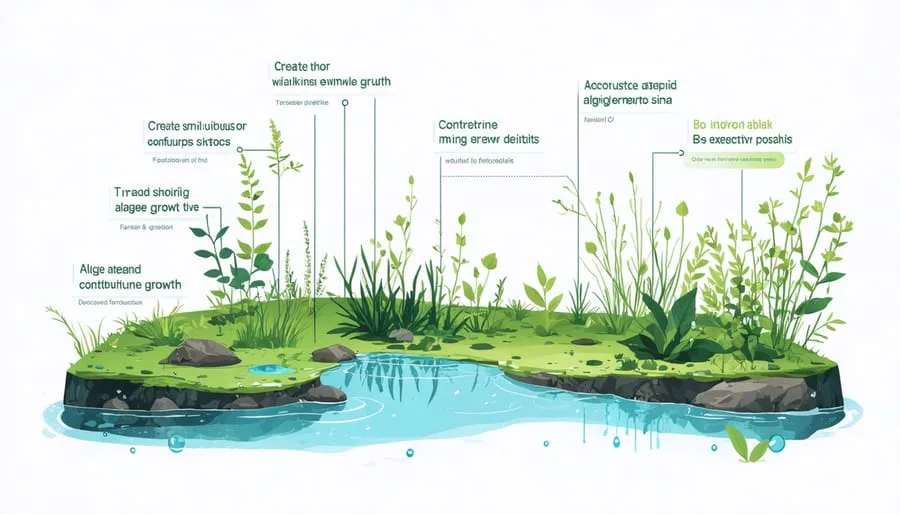
Image source: Bing (Web (fair-use with source credit))
Nutrient overload
Fish waste, uneaten food, dead leaves, grass clippings, and lawn fertilizer that runs off after rain all feed algae. Nitrogen and phosphorus are the two main nutrients at work. Per University of Minnesota Extension, limiting nutrient runoff is the first step in reducing algae problems in private ponds.
Too much sunlight
Algae behaves like plants. It needs light to photosynthesize. If your pond gets more than six hours of direct sun a day, you're giving algae everything it needs.
Floating plants, water lilies, and even a shade sail can cut light levels and slow the bloom.
Weak biological filtration
Beneficial bacteria break down ammonia and nitrite before they become plant food. That bacteria needs oxygen, warm water, and lots of surface area. Most pond filters ship with too little bio media, or the pump is too small.
The result is a filter that moves water but barely processes waste.
Low oxygen levels
When dissolved oxygen drops below 5 ppm, the bacteria slow down and anaerobic conditions take over. Algae actually thrives in those conditions. Adding an air pump, diffuser, or fountain is often the fastest single improvement you can make.
| Cause | What you might notice | First natural move |
|---|---|---|
| Nutrient overload | Green or cloudy water, sludge on the bottom | Feed less, remove debris, skip chemical fertilizers near the pond |
| Too much sunlight | Algae blooms worse in summer, clear in winter | Add floating plants for 30-50% surface coverage |
| Weak biological filtration | Ammonia or nitrite spikes, slow clearance | Add more bio media and let the filter run continuously |
| Low oxygen levels | Fish gasp at the surface, string algae on rocks | Run an air pump 24/7 |
Your Decision Tree Based on What You Actually See
Stop guessing. Match what's in front of you to the right path. The fix for green water is useless for string algae, and the fix for string algae won't cure murky sediment.
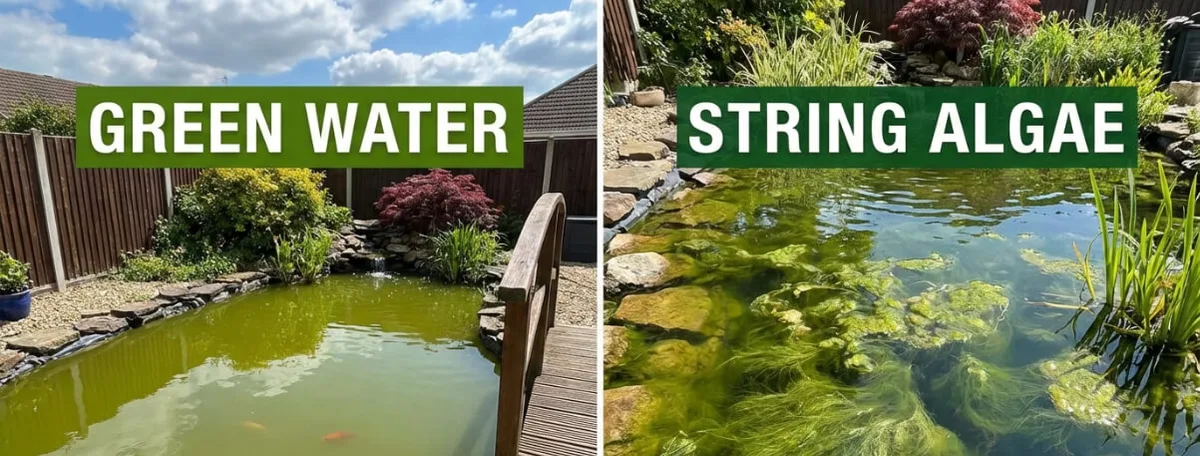
Image source: Bing (Web (fair-use with source credit))
- Bright green water. Your whole pond looks like pea soup. This is suspended algae, and it means too many nutrients in the water column. Focus on feeding less, adding plants, and boosting your biofilter.
- Long green or brown strands. String algae, also called filamentous algae, clings to rocks, liner, and plant stems. It grows on surfaces. That's usually a phosphate problem. Pull what you can, reduce fish waste, and add oxygenating plants.
- Milky or brown water after rain. That's sediment stirred up by runoff, not algae. It settles on its own after a few days. But if it keeps happening, you have muck at the bottom. Vacuum the sludge and add beneficial bacteria.
- Oily surface film or tiny green specks near the edge. This is often a biofilm and a small population of algae that doesn't get filtered out. Both improve with better aeration and regular skimming.
If you're still unsure, test the water. Ammonia above 0.5 ppm or nitrite above 0.5 ppm points to a filter that can't keep up. Nitrate above 40 ppm tells you the water is fertile enough to feed algae.
Phosphate above 0.5 ppm makes string algae almost inevitable.
| Condition | First 48 hours | Next 2 weeks |
|---|---|---|
| Green water | Test water, cut feeding by half | Add floating plants and bacteria |
| String algae | Pull out all strands by hand | Add oxygenators, check phosphate |
| Murky sediment | Stop water flow, let it settle | Vacuum the bottom, add bacteria |
| Oily film | Skim the surface | Add aeration |
Step-by-Step Fix for Greens, Fuzz, and Everything in Between
Once you know the cause, the fix follows a set order. Skip a step and you'll only get partial results. Here's the order that works for most backyard ponds.
Test your water. Measure ammonia, nitrite, nitrate, phosphate, and pH. Nitrate under 40 ppm is a reasonable goal. Phosphate should be under 0.5 ppm. Test again after a week to see if your steps are working.
Cut the nutrient supply. Feed fish only what they eat in two minutes. Remove dead leaves and stray grass clippings before they settle. Redirect downspouts and lawn sprinklers away from the pond. If runoff crosses your lawn, it picks up fertilizer before it reaches the water.
Reduce the fish load. Overstocked ponds never clear up naturally. A general rule is one 4-inch fish per 50 to 100 gallons of water, depending on filtration. If the pond is packed, rehoming some fish is the most effective thing you can do.
Upgrade the biofilter. Add more biological media like lava rock, ceramic rings, or bio balls. A simple bog filter built into the edge of the pond works wonders because it gives bacteria surface area and growing space. Toss in a dose of beneficial bacteria after you clean the filter, not before.
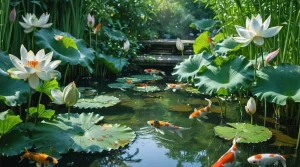
Add the right plants. Aim for 30-50% surface coverage. Floating plants like water lettuce and water hyacinth block sunlight. Oxygenators like hornwort and anacharis soak up nutrients from the water column. Choose native options if invasive species are restricted where you live.
Aerate around the clock. Run an air pump or fountain 24/7. A diffuser on the pond floor moves the entire water column and keeps oxygen levels stable. In hot weather, this matters twice as much because warm water holds less oxygen.
Barley straw is a maintenance tool, not an emergency fix. Apply it in early spring at a rough rate of 1-2 bales per 1,000 gallons, or about 225 g per 1,000 liters. It takes six to eight weeks to produce results.
| Action | When you'll see results |
|---|---|
| Cut feeding and reduce fish load | 2-4 weeks, if nutrients are the problem |
| Add beneficial bacteria | 2-6 weeks |
| Add floating plants | 4-8 weeks |
| Add barley straw in early spring | 6-8 weeks |
5 Mistakes That Keep Your Pond Green No Matter What You Try
These are the common reasons natural fixes fail. Some are obvious. Others are things you've probably done for years without realizing they still feed algae.
Changing the water every few days. Tap water can contain nitrates and phosphates. Large water changes also shock fish and restart the biological cycle. Instead, do small 10-20% changes once a month if you need to. The goal is fixing the source, not diluting the evidence.
Adding fish while you're trying to clear the water. Every fish adds waste. New fish add stress to existing fish and the filter. The pond can't clear up while the bioload keeps growing. Wait until the water is stable before adding anything new.
Using algaecides "just this once." Algaecides kill algae quickly, but they don't remove the food source. The nutrients stay dissolved, so the bloom comes back. Worse, the dead algae rots and creates even more fuel. Some algaecides also kill beneficial bacteria and lower dissolved oxygen.
Planting the wrong plants. A single water lily won't shade a large pond. Some popular floating plants, like water hyacinth, are invasive and illegal in certain states. Pick native, fast-growing plants that cover at least a third of the surface. Check with a local extension service before planting anything.
Shutting off the pump or aerator at night. Photosynthesis stops after dark, so oxygen drops. That's exactly when your filter bacteria need oxygen to keep consuming fish waste. Keep the air pump running 24/7, especially in the summer. Letting it go dark and stagnant is an invitation for another algae bloom.