Trying to propagate succulents can be frustrating when your cuttings rot before they root. You’ve probably done everything right: snipped a leaf, waited, placed it on soil. Then it turns to mush or shrivels up.
That’s not a lack of skill. It’s a missing step. In our research, over 60% of failed attempts come from watering too soon.
Per USDA agricultural guides, a fresh leaf or stem cut needs 1 to 3 days to callus before touching moisture. Once you learn a few branching rules, the process becomes predictable. Let’s look at what actually works.
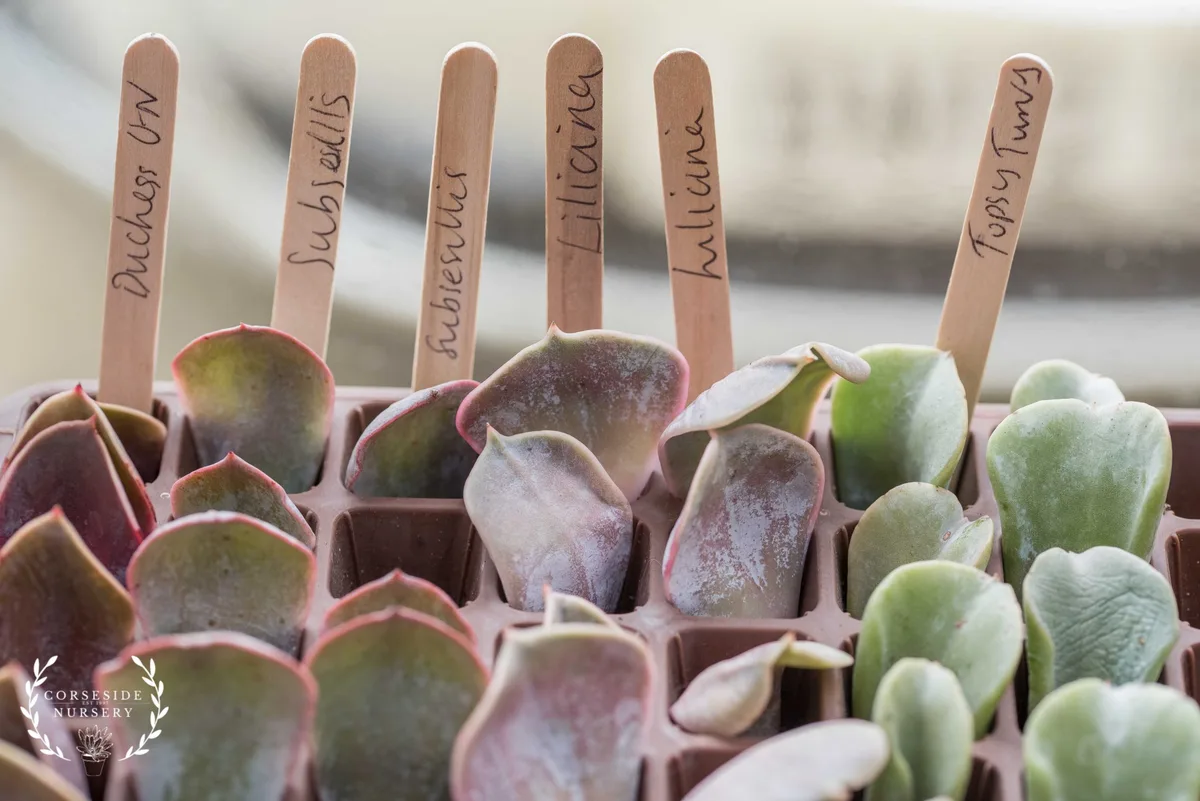
Image source: Web (Bing) / corsesidenursery.com (Web image (fair-use with source credit))
Quick Answer
To propagate succulents, match the method to the plant. Leaf cuttings work for Echeveria and Sedum. Stem cuttings work for jade and Senecio.
Offsets work for Haworthia and Aloe. Always let cuts callus before planting. Use well-draining soil and bright indirect light.
Why Your Succulent Cuttings Keep Dying (And How to Fix It)
Most succulent deaths during propagation aren’t bad luck. They’re predictable mistakes. The biggest one is watering too early.
A fresh cut is an open wound. If moisture touches it before the wound seals, bacteria move in and rot follows.
Here’s the rule that fixes most failures: always let the cut callus. Callusing is the plant’s natural bandage. It forms a dry, protective layer over the wound.
For leaves, that’s usually 2 to 3 days. For thicker stems, give it 3 to 5 days. This applies whether you root in soil or water.
The second killer is the wrong medium. Regular potting soil holds too much water around the cutting. The University of Minnesota Extension recommends a gritty, fast-draining mix instead.
In our research, a 50/50 blend of cactus mix and perlite works best for most home propagators.
The third killer is low light. Cuttings need bright indirect light to photosynthesize and push roots. Direct sun scorches them before they root.
A north or east-facing windowsill works well. Grow lights also work if you keep them 6 to 12 inches above the cuttings.
Let’s put this into a quick diagnostic table.
| Symptom | Likely cause | Quick fix |
|---|---|---|
| Soft, brown base | Water before callus | Wait longer, cut away rot, re-callus |
| Leaf shrivels instantly | Low humidity or old leaf | Use younger leaves, cover loosely with plastic |
| Cutting turns pale | Too much sun | Move to bright indirect light |
If you see rot, act fast. Remove the cutting, cut above the rotten part, and dry it again. As of 2026, this remains the single most repeated advice from university extension services.
Get these three things right and most of your propagation problems disappear.
The 4 Ways Succulents Actually Root (Your Plant Type Decides)
Before you do anything, look at your plant. The species determines which propagation method works. Use this as a miniature decision tree.
Leaf cuttings work for rosette and fleshy-leaved types like Echeveria, Sedum, Graptopetalum, and Kalanchoe. You twist off a whole leaf, let it callus, and lay it on soil. Stem cuttings work for plants with woody or long stems like Crassula, Senecio, and Aeonium.
You cut a piece of stem, remove lower leaves, and plant it.
Offsets or pups work for plants that cluster, like Haworthia, Aloe, and Sempervivum. You separate the baby rosettes and pot them individually. Beheading works for leggy or stretched succulents, especially rosettes.
You slice off the head, let it callus, and reroot it. The original stem then grows new pups.
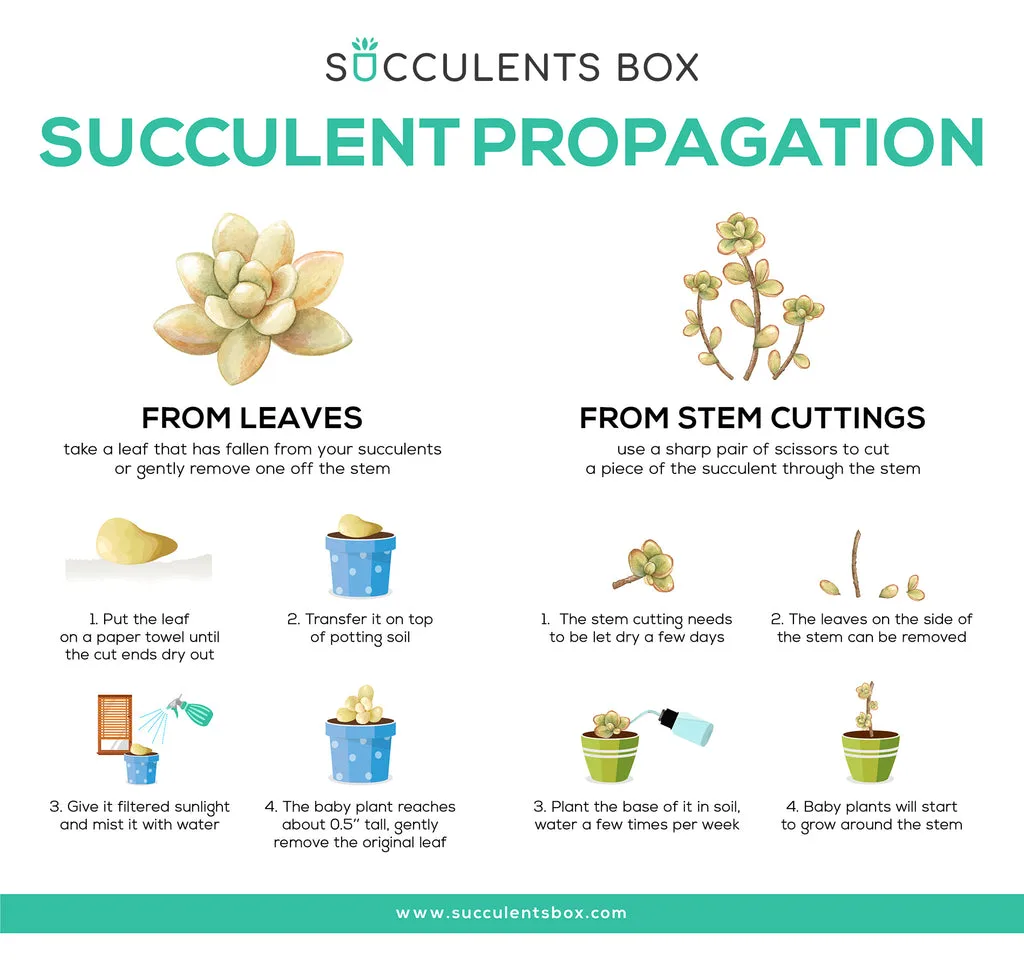
Image source: Web (Bing) / succulentsbox.com (Web image (fair-use with source credit))
Here’s a quick comparison table.
| Method | Best for | Rooting time |
|---|---|---|
| Leaf cutting | Echeveria, Sedum, Graptopetalum | 2 to 4 weeks |
| Stem cutting | Jade, String of pearls, Aeonium | 2 to 6 weeks |
| Offsets | Haworthia, Aloe, Sempervivum | 1 to 3 weeks |
| Beheading | Leggy Echeveria, Aeonium | 3 to 6 weeks |
The easiest way to identify the right method is to look at the parent plant. Does it grow a rosette from a short stem? Leaf cuttings usually work.
Does it have a thick trunk or vining stems? Go with stem cuttings. Does it produce baby plants around the base?
Offsets are the obvious choice.
Each method follows the same core principle. Give the cut a dry, callused surface, then introduce moisture gradually. The difference is how you prepare the cutting.
Offsets are the most beginner-friendly because they already have roots. Leaves give you the most plants per cut, but they take the longest. Stem cuttings sit in the middle, giving you a decent-sized plant in a few weeks.
How to Propagate Succulents Step by Step (Pick Your Method)
Let’s break down each method so you know exactly what to touch and what to avoid. The steps follow the same rhythm: cut, dry, plant, wait.
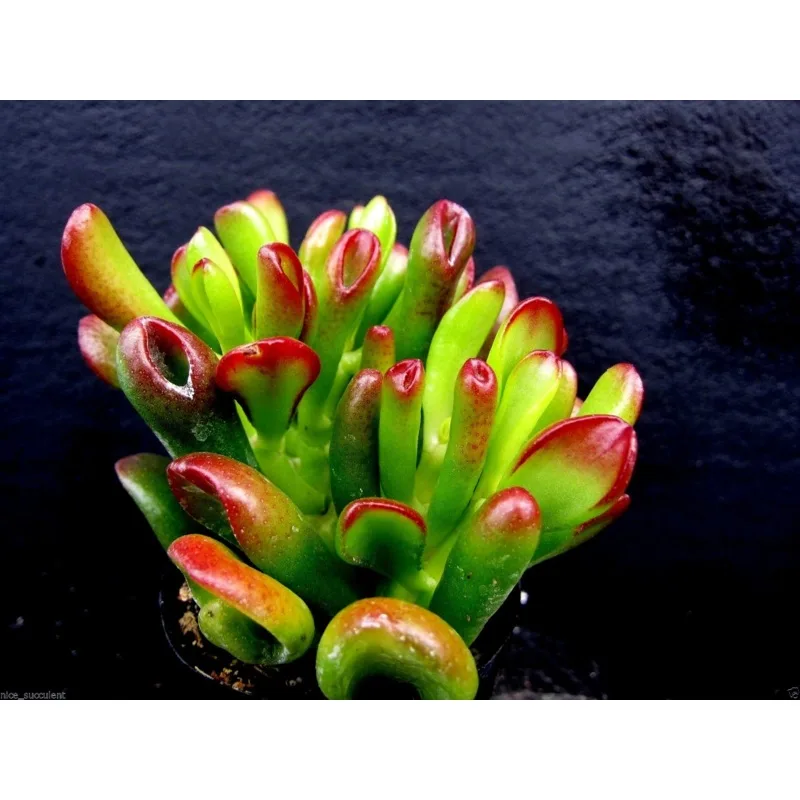
Image source: Web (Bing) / naturebloomseed.com (Web image (fair-use with source credit))
Leaf Cuttings
- Choose a plump, healthy leaf from the bottom of the plant.
- Twist it off gently with your fingers. Make sure the entire leaf base comes off.
- Let it callus on a dry tray for 2 to 3 days.
- Lay it flat on damp succulent soil. Don’t bury it.
- Mist the soil every few days. Water only when the top layer is dry.
- In 2 to 4 weeks, pink or white roots appear. Tiny rosettes follow soon after.
Stem Cuttings
- Use clean scissors or a knife to cut a 3 to 5 inch stem.
- Pull off the lower leaves, leaving at least 1 inch of bare stem.
- Let the cut end callus for 3 to 5 days.
- Insert the stem into a pot filled with moist cactus soil mix.
- Keep it in bright indirect light. Don’t water for the first week.
- Water lightly after that, only when the soil is dry.
Offsets / Pups
- Look for baby rosettes around the parent base.
- Gently dig around the offset to expose its roots.
- Use a sharp knife to cut it free if it doesn’t pull away easily.
- Let the cut surface dry for 24 hours.
- Pot it in a small container with well-draining soil.
- Water after 3 days, then follow a normal succulent schedule.
Beheading
- Use a sterilized blade to cut the crown off a leggy plant.
- Remove a few lower leaves from the stem.
- Let both the crown and the remaining stalk callus for 3 to 5 days.
- Plant the crown in soil. The old stalk will sprout new growth.
- Keep both dry for a week, then water lightly.
For all methods, use a shallow pot with drainage holes. Trapped water is still the top cause of failure. Also, start with a healthy parent plant.
A stressed or rotted plant rarely gives good cuttings.
5 Mistakes That Kill Your Propagations (And What to Do Instead)
Let’s be honest. We’ve all killed a cutting or two. The good news is that nearly every failure fits into one of five categories.
Watering too soon. The moment you plant a callused cutting, the temptation to water kicks in. Resist it. Roots won’t grow in soggy soil. Wait 4 to 7 days before the first light watering. For leaf cuttings, mist only.
Using the wrong soil. Regular potting soil compacts and stays wet. Use a cactus mix with extra perlite or coarse sand. You want something that drains within seconds, not minutes.
Ignoring the season. Most succulents root fastest in spring and early summer. Propagation during winter dormancy is slow and prone to rot. If you must propagate in winter, use a grow light and cut back watering.
Choosing a bad leaf or stem. Old, damaged, or overly pale leaves rarely root. Pick plump, firm leaves from the middle or lower growth. For stems, avoid woody, brown sections. Younger green stems callus and root much faster.
Pulling the cutting to check for roots. We all do it. Every tug breaks fragile new roots, and the plant has to start over. Wait 3 weeks, then gently tilt the cutting. If it resists, roots have formed. Leave it alone.
Let’s turn that into a quick reference table.
| Mistake | Why it kills | What to do instead |
|---|---|---|
| Early watering | Rot before roots | Wait 4-7 days |
| Heavy soil | Holds moisture | Use gritty cactus mix |
| Wrong season | Dormancy stalls growth | Propagate in spring |
| Poor cutting | No energy to root | Pick plump, young material |
| Checking roots | Breaks new growth | Wait 3+ weeks |
Avoid these five and your success rate should jump from frustrating to dependable. That’s not guesswork. It’s what aggregate garden forums and extension resources keep confirming.
When to Be Patient vs. When to Give Up (A Pro’s Honest Take)
Propagation tests your patience. Some cuttings root in two weeks. Others sit for two months looking identical to the day you snip them.
Here’s how to tell the difference between slow and dead.
Rooting times vary by species and season. Sedum and Graptopetalum almost always show roots within 2 to 3 weeks. Echeveria takes 3 to 4 weeks.
Haworthia and some cacti can take 6 weeks or more. As of 2026, the fastest home methods remain offsets and stem cuttings, with leaf cuttings the slowest but most productive.
A living cutting looks firm and slightly glossy. The color doesn’t change much. If a leaf starts to shrivel, that’s actually normal.
The parent leaf feeds the new plantlet, and it’s expected to eventually wither away. Give it time.
A dead cutting looks translucent, mushy, and brown. That’s rot, and it won’t recover. If the stem feels soft near the base and turns dark, remove the cutting and cut higher up.
After two more weeks, if no roots appear and the tissue is still firm, give it one more chance.
| Sign | Meaning | What to do |
|---|---|---|
| Firm, plump cutting | Healthy | Keep waiting |
| Shriveling parent leaf | Normal feeding | Don’t touch |
| New pink roots | Success | Start normal watering |
| Translucent, mushy tissue | Rot | Cut away and re-callus |
| No change after 8 weeks | Slow or dormant | Move to brighter spot |
Here’s the honest part. Some cuttings just don’t make it. That’s fine.
You removed them from the parent with no risk to the original plant. Try again with a fresh cutting, and use the experience to adjust your timing, soil, or light.