You walk past your roses one morning, and they look like someone took a hole punch to every leaf. If you've ever seen that lacy, skeletonized damage, you already know the culprit: the Japanese beetle. This pest is one of the most destructive garden invaders in the eastern half of the U.S., and getting rid of it starts with knowing exactly what you're looking at.
The Japanese beetle was first discovered in New Jersey back in 1916, and as of 2026, it's established in nearly every state east of the Mississippi River. Per USDA Animal and Plant Health Inspection Service tracking, the beetle now costs homeowners, nurseries, and farms over $460 million annually in control and replacement plantings. That's a serious number for a bug smaller than a dime.
But here's the thing: you need to get the eyes right first.
Quick Answer
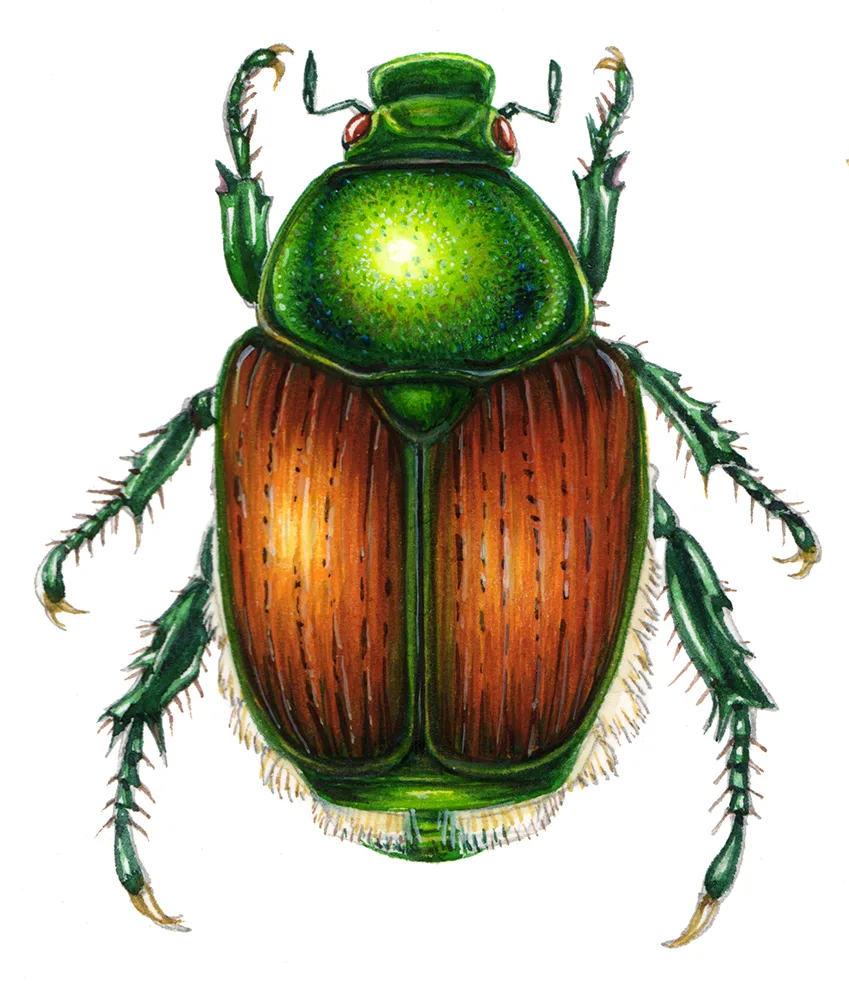
The Japanese beetle is a metallic green and copper-brown beetle about half an inch long. It has five white tufts on each side of its abdomen. Adults skeletonize leaves by eating tissue between the veins.
Grubs in the soil feed on grass roots. Identification is the first step to control.
Why Getting the Eyes Right Matters
Here's a mistake people make every single summer: they see a shiny green beetle on a rose and immediately break out the spray. But not every metallic beetle is a Japanese beetle. Misidentifying it means you waste time, money, and quite possibly kill the pollinators your garden actually needs.
The problem gets worse when people treat blindly for grubs. Many home lawn products are broad-spectrum. Apply them at the wrong time or for the wrong pest, and you're nuking beneficial insects along with the grubs you might not even have.
Our research shows that misidentification is the number one reason control efforts fail.
So why does this matter so much? Because the Japanese beetle has a specific lifecycle, specific feeding patterns, and specific weak points. But those weaknesses only line up if you've correctly identified both the adult beetle AND the grub.
Get it wrong, and you're throwing solutions at a problem you don't actually have.
The visual cues are your best friend here. Once you know what to look for, you can confirm the pest in under 30 seconds. That saves you from buying the wrong traps, applying the wrong sprays, or digging up your lawn for no reason.
How to Spot a Japanese Beetle (Without Guessing)
Let's start with the adult. This is the beetle you see on your roses, grapevines, and linden trees from late June through August. It's not hard to spot once you know the checklist.
The first thing you'll notice is the color. The head and thorax are an iridescent metallic green. The wing covers are a coppery brown.
If you've ever seen an emerald ash borer or a green June beetle, don't confuse them. This beetle has a combination of green and copper that's unique.
Here's the most critical visual cue: the white tufts. The Japanese beetle has five distinct white tufts of hair on each side of its abdomen. They look like little fuzzy patches.
You can see them when the beetle's wings are slightly spread, and on some specimens, you can see a tiny patch even from the top.
The beetle is about 10 to 12 millimeters long, roughly the size of a pencil eraser. It's not huge, but it's not tiny either. When you see one, you know it's a beetle.
Now, what about the grub stage? The grub is C-shaped, white or cream-colored, with a brown head. It lives in the soil, feeding on grass roots.
The key visual here is the raster pattern. That's the set of bristles on the underside of the grub's abdomen. The Japanese beetle grub has a distinctive V-shaped row of bristles.
If you dig up a grub and it doesn't have that V pattern, it's likely a different species.
You can confirm this with a quick look. A hand lens or even a good phone camera zoom will show you the raster pattern. That's the grub's unique fingerprint.
The Damage They Leave Behind (And What It Tells You)
The damage from Japanese beetles is almost as distinctive as the beetle itself. If you learn to read the damage, you can often diagnose the problem before you even see a single bug.
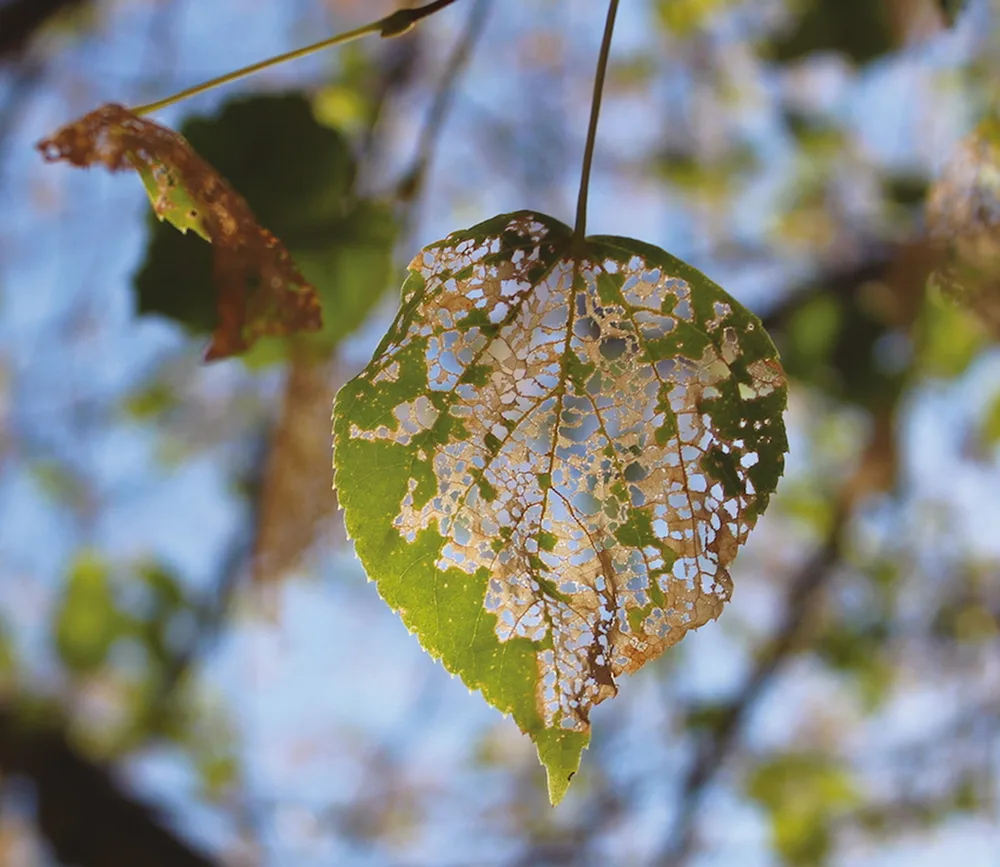
Adult beetles skeletonize leaves. That means they eat the soft tissue between the veins and leave the veins intact. The result is a leaf that looks like lace or a leaf skeleton.
This is not the same as chewing damage from caterpillars or slugs. Those pests often make holes or ragged edges, but they don't leave that delicate lacework.
You'll see this damage first on plants the beetles love most. Roses, lindens, grapes, birch, crabapples, and sassafras are all favorites. If you have any of those, check them regularly.
In the lawn, the tell is different. Grub damage shows up as irregular brown patches that peel back easily. If you pull at the turf and it lifts like a rug, you've likely got grubs feeding on the roots beneath.
Skunks and raccoons will often dig up those patches to eat the grubs, turning a brown patch into a full excavation site.
But here's the thing. Brown patches in lawns can be caused by drought, fungus, or other pests. You need to dig.
A quick inspection with a shovel will tell you. If you find 10 to 12 grubs per square foot, that's above the damage threshold. You have an infestation.
If you find fewer, you might not need to treat. The visual evidence at the soil level is the only way to know for sure.
The Lookalike Problem: Beetles That Fool Everyone
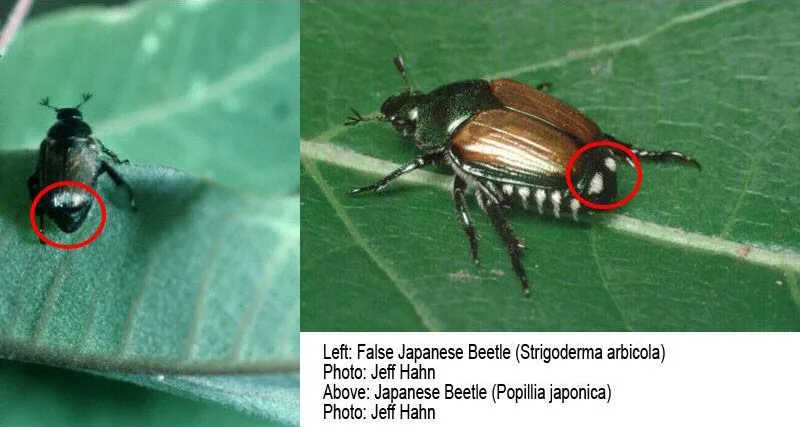
Image source: Web (Bing) / pinterest.com (Web image (fair-use with source credit))
This is where most people go wrong. There are several beetles that look similar to the Japanese beetle, and treating for the wrong one is a waste of resources.
The most common mistaken identity is the false Japanese beetle (Strigoderma arbicola). This beetle has a similar shape and color, but it lacks those five distinct white tufts. Instead, it has white spots and a duller appearance.
It's not an agricultural pest, so you don't need to spray for it.
Next up is the green June beetle (Cotinis nitida). This one is larger, about an inch long, and it's a vibrant metallic green with no copper. It flies slowly and noisily, often bumping into things.
Japanese beetles are smaller and more agile. The green June beetle grub is also a C-shaped white grub, but it crawls on its back on the soil surface. That's a dead giveaway.
Then there are cucumber beetles and other scarab beetles. They don't have the same copper sheen or the white tufts.
Here's a quick visual guide to help you tell them apart.
| Feature | Japanese Beetle | False Japanese Beetle | Green June Beetle |
|---|---|---|---|
| Length | 10-12 mm (pencil eraser) | 8-10 mm (slightly smaller) | 20-25 mm (almost 1 inch) |
| Color | Metallic green head + copper wing covers | Duller green with white spots | Uniform metallic green, no copper |
| White tufts | 5 prominent white tufts per side | White spots, not tufts | No tufts |
| Flight behavior | Quick, direct, day-flying | Similar to Japanese beetle | Slow, noisy, bumps into things |
| Damage | Skeletonized leaves | Minimal, not a pest | Feeds on fruit, not leaves |
If you're looking at a beetle and you're not sure, check for those white tufts. That's the easiest single identifier. No tufts?
It's not a Japanese beetle.
Step-by-Step: How to Get Rid of Them Using What You See
Once you've confirmed you're dealing with Japanese beetles, the next step is to take action. But the right action depends on what stage of the lifecycle you're seeing.
If you see adults on plants
The most straightforward approach is hand-picking. Yes, it's tedious, but for small gardens, it works. Go out early in the morning when the beetles are cold and sluggish.
Knock them off into a bucket of soapy water. They can't fly well when it's cool, so they'll drop right in.
If you have a larger garden, you can use a spray. Neem oil works as a repellent and an antifeedant. Per manufacturer specifications, you mix 2 tablespoons of cold-pressed neem oil concentrate per gallon of water.
Spray in the evening to protect bees. Repeat every 7 to 14 days during peak activity.
Pyrethrin-based sprays offer faster knockdown, but they're also more toxic to pollinators. Use them only as a last resort, and always at dusk.
Pheromone traps are a trap. Our research shows that traps attract many more beetles than they catch (as many as 50% of the beetles in the area are lured in). If you place a trap near your prized roses, you're summoning beetles from three blocks away.
If you must use a trap, place it at least 30 feet from any plant you want to protect.
If you see grubs in the lawn
This is where long-term control happens. The best times to treat grubs are late summer (August to September) and early fall. That's when young grubs are near the surface and feeding actively.
Milky spore disease is a biological agent that targets Japanese beetle grubs specifically. One application can persist in the soil for 10 years or more. Apply it in late summer.
The typical coverage is 1 pound per 4,000 square feet.
Beneficial nematodes are another excellent option. Heterorhabditis bacteriophora and Steinernema feltiae species attack and kill grubs. You need to apply them when the soil temperature is above 60 degrees Fahrenheit. Keep the soil moist for two weeks after application so the nematodes can travel.
A systemic insecticide like imidacloprid can work, but it's toxic to bees in the adult stage. If you use it on the lawn, it won't directly harm bees unless they're foraging on flowering weeds. But many states restrict its use.
The combined approach
The best strategy for most homeowners is to use a combination. Treat the lawn with milky spore or nematodes in late summer. Then hand-pick or spray adults in the garden during peak season.
Over a few years, you'll see the population drop. The key is consistency. Japanese beetles are here to stay, but you can push them back to manageable levels.
The Worst Mistakes People Make When Trying to Control Them
Even with the right identification, homeowners still fumble the control step. These are the most common errors we see, and they all have straightforward fixes.
Placing traps right next to prized plants
Pheromone traps are a magnet, not a solution. They lure beetles from up to a mile away. If you hang a trap near your roses, you're throwing a welcome party for every beetle in the neighborhood.
Always place traps at the far edge of your property, at least 30 feet from any plant you want to protect.
Spraying during the middle of the day
Neem oil and pyrethrin both harm bees if applied while they're foraging. Midday spraying turns your treatment into a pollinator massacre. Apply sprays in the evening, after bees have returned to their hives.
You'll still hit the beetles, and you'll spare the beneficials.
Treating for grubs in the spring
Here's a counterintuitive fact: spring is the wrong time. Spring grubs are large, mature, and less susceptible to treatments. The window that actually works is late summer, from August to September.
That's when newly hatched grubs are small, near the surface, and feeding actively. Timing matters more than product choice.
Skipping the soil check entirely
Many people treat their lawn for grubs without ever digging a single square foot. That's a gamble. If you find fewer than 10 grubs per square foot, treatment isn't justified.
Dig a few test patches before you spend money. The soil tells the truth.
Relying on a single treatment
One spray won't fix a beetle problem. Adults keep emerging for six to eight weeks. You need repeated applications, combined with grub control, to see a real population drop.
Consistency is the whole game.
Frequently Asked Questions
Are Japanese beetle traps effective?
Traps catch thousands of beetles, but they attract more than they capture. Research from university extension programs shows traps can increase local damage by up to 50%. Use them only as a monitoring tool or place them far from ornamental plants.
What naturally kills Japanese beetles?
Milky spore disease targets and kills grubs in the soil. Beneficial nematodes do the same within days. For adults, neem oil acts as a repellent and feeding deterrent.
Hand-picking into soapy water works for small gardens.
Do geraniums really poison Japanese beetles?
Yes. Geraniums contain a compound that temporarily paralyzes beetles. Affected beetles fall to the ground, unable to move.
They recover within 24 hours, but you can easily collect and dispose of them while they're down.
What eats Japanese beetles?
Birds, including starlings, crows, and robins, feed on both adults and grubs. Spiders, ants, and predatory wasps consume eggs and larvae. Possums and skunks dig up grubs in lawns.
Encouraging these predators helps keep populations in check.
Can I compost plants with Japanese beetle damage?
Yes, safely. The adult beetles don't lay eggs in compost piles. However, they can hitchhike on plant material.
Heat your compost above 130 degrees Fahrenheit for several days to kill any hidden pests, or freeze infested clippings before adding them.
Which states have Japanese beetle quarantines?
The beetle is established in every state east of the Mississippi River. Partial infestations exist in Texas, Kansas, Nebraska, and South Dakota. Western states like California, Oregon, and Washington maintain strict quarantines on shipped plants and sod.
Check the USDA APHIS website for current regulated areas.