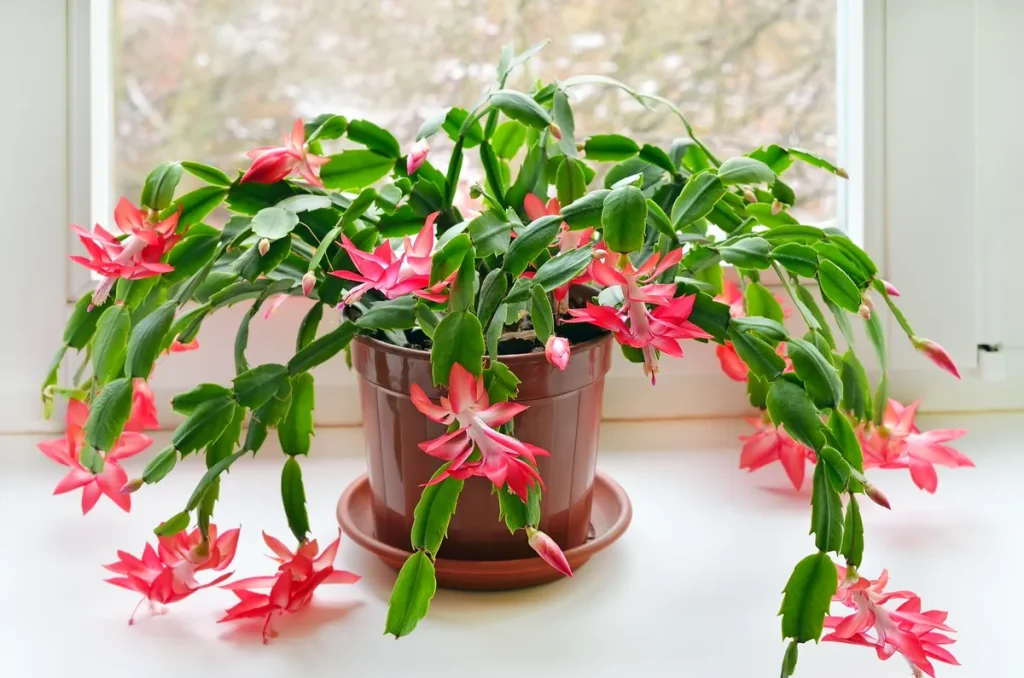
If your holiday cactus has never bloomed on schedule, the problem isn't your care. Holiday cactus care actually starts before you even water or fertilize. It starts with identification.
What you call a Christmas cactus might be a completely different species that blooms weeks earlier or later.
True Christmas cacti (Schlumbergera bridgesii) have scalloped leaf margins, while Thanksgiving cacti (Schlumbergera truncata) have pointed, claw-like segments. These are not just fun facts. They determine when and how your plant needs rest, light, and water.
Let's look at the key difference first.
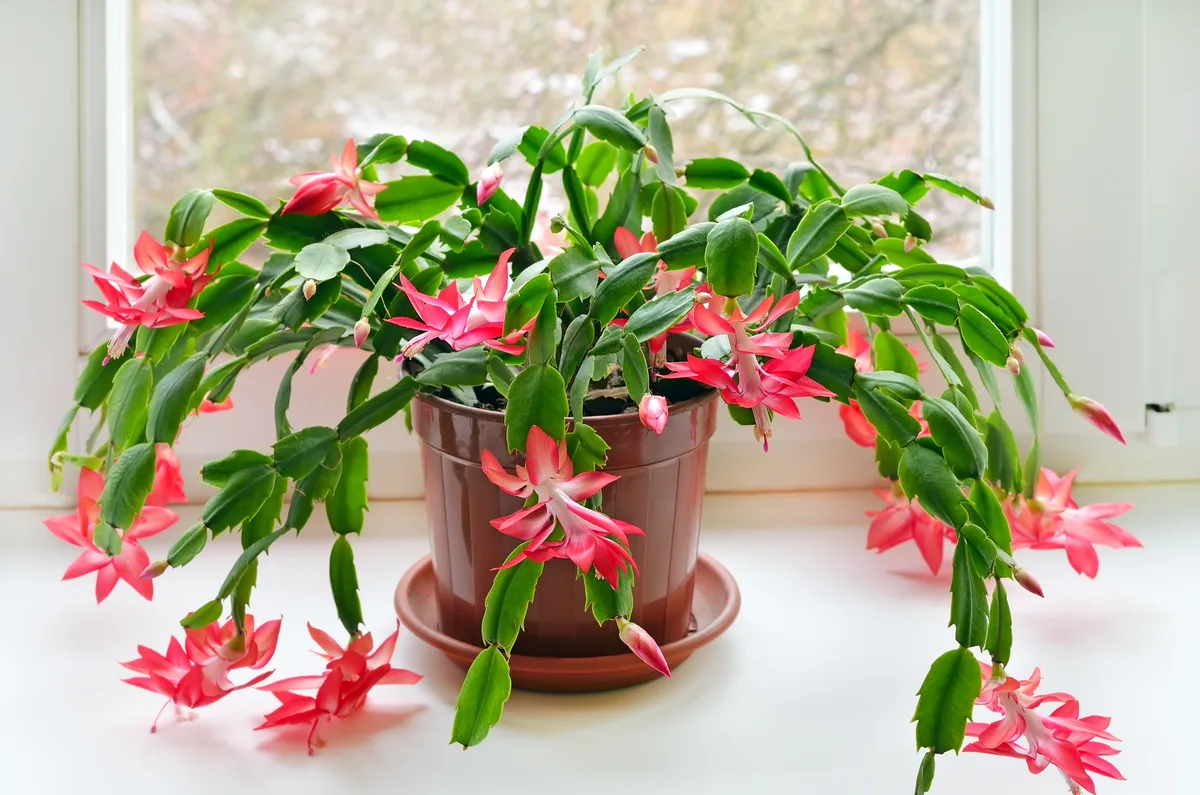
Image source: Bing (Web (fair-use with source credit))
Why Your "Christmas Cactus" Might Not Be a Christmas Cactus
Most people learn this the hard way. You buy a cactus covered in pink blooms in November, and you call it a Christmas cactus. But per research from the University of Florida IFAS Extension, the plant sold in November is almost certainly a Thanksgiving cactus.
The real Christmas cactus peaks in late December.
The confusion is understandable. Big box stores and grocery chains label them all the same. But the bloom season reveals the truth.
Thanksgiving cacti set buds when nights get longer in autumn, and they open by late November. Christmas cacti need another month of cool nights, so they open around the winter solstice.
Easter cacti (Rhipsalidopsis gaertneri) are the third type. They bloom in spring, not winter. Their leaf segments are round with fuzzy edges, no points or scallops at all.
So if you followed holiday cactus care advice from a friend and it failed, you might have the wrong species.
When you know the type, everything else clicks into place. You know when to start the darkness treatment, when to let the plant rest, and when you can safely repot.
The 30-Second Leaf Test: Identify Your Cactus
You do not need a botanist or a lab test. Look at the leaf segments, the flattened green parts that look like leaves. Here is what to look for, and what diagram or photo would show.
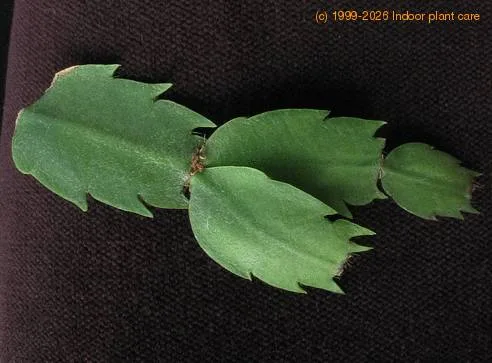
Image source: Web (Bing) / hrovatin.com (Web image (fair-use with source credit))
| Type | Scientific name | Leaf segment shape | Typical bloom window |
|---|---|---|---|
| Thanksgiving cactus | Schlumbergera truncata | Pointed, claw-like, toothed | Mid November to early December |
| Christmas cactus | Schlumbergera bridgesii | Scalloped, rounded | Mid December to late January |
| Easter cactus | Rhipsalidopsis gaertneri | Round, fuzzy, no teeth | March to April |
Run your finger along the edge of one segment. If it feels sharp like a crab claw, it is a Thanksgiving cactus. If it feels smooth with gentle curves, Christmas.
If it is fuzzy with tiny hairs, Easter.
A common visual mistake is looking at the flower shape instead. The flowers do differ, but you only see them for a few weeks. The leaf segments are always there.
Use them for identification.
Once you know your type, you can stop guessing.
Year-Round Care Routine for Each Type
The good news: all three types need the same basic conditions. The bad news: they need them at different times of year.
Light and location. Bright but indirect light is the rule. Direct afternoon sun will scorch the leaves and turn them purple or red. A north or east facing window works well.
In the height of summer, move the plant back from the glass so it gets no sun at all from 11 am to 4 pm.
Watering. Holiday cacti are epiphytic. They live on tree bark in nature, not in rich soil. This means they hate sitting in water.
Allow the top 2 to 3 centimeters of soil to dry out completely before watering. Then water deeply and let the pot drain fully. Never let water collect in a saucer or decorative pot.
Temperature. The ideal range during growth is 15 to 24 degrees Celsius (60 to 75 degrees Fahrenheit). Cooler temperatures at night, around 10 to 15 degrees Celsius (50 to 60 degrees Fahrenheit), help trigger bud formation in autumn.
Fertilizer. Feed monthly with a balanced liquid houseplant fertilizer at half strength during the active growing season, from early spring through late summer. Do not fertilize during the bloom period or the winter rest.
Repotting. Only repot after the plant has finished blooming, and only one pot size up. These plants like being root bound. A pot that is too large will retain water and cause rot.
Use a very loose, fast draining mix. Orchid bark mixed with regular potting soil at a 2:1 ratio works well.
For each season of holiday cactus care, the simplest approach is to match water and light to what the plant would experience in its native Brazilian cloud forest. Warm and damp in summer, cool and dry in winter.
5 Mistakes That Send Your Holiday Cactus to the Grave
These are the patterns we see repeated in aggregate reviews and plant forums. Avoiding them means your cactus can live for decades.
1. Overwatering. This is the number one killer. Wet soil suffocates the fine root system and leads to root rot.
You do not need to water on a schedule. You need to water when the soil feels dry at your second knuckle.
2. Placing it in direct sunlight. A south facing window in winter might seem kind, but the winter sun is still intense enough to burn the leaves. You will see yellow patches or reddish discoloration.
Pull the plant back a meter from the window.
3. Repotting during bloom. The moment your cactus has buds or flowers, do not move it to a new pot or soil. The plant will drop every bud in response to the root disturbance.
Wait until the last flower fades.
4. Sudden temperature changes. Holiday cacti drop buds if the temperature swings more than a few degrees in a short period. Do not set the plant near a heater vent, a drafty window, or a door that opens to the outside.
5. Not giving a dark period. Without 14 hours of uninterrupted darkness in autumn, the plant will not set buds. Even a porch light from outside or a lamp left on in the room can disrupt the cycle.
If you catch a mistake early, the plant is forgiving. A limp, overwatered cactus can be saved by removing it from the soil, trimming rotten roots, and letting it dry out for two days before repotting into fresh mix.
How to Force Blooms (The Photoperiod Trick)
As of 2026, the most reliable method for forcing blooms is still the long night treatment. Holiday cacti are short day plants. They form buds when nights are longer than about 14 hours.
Here is the process.
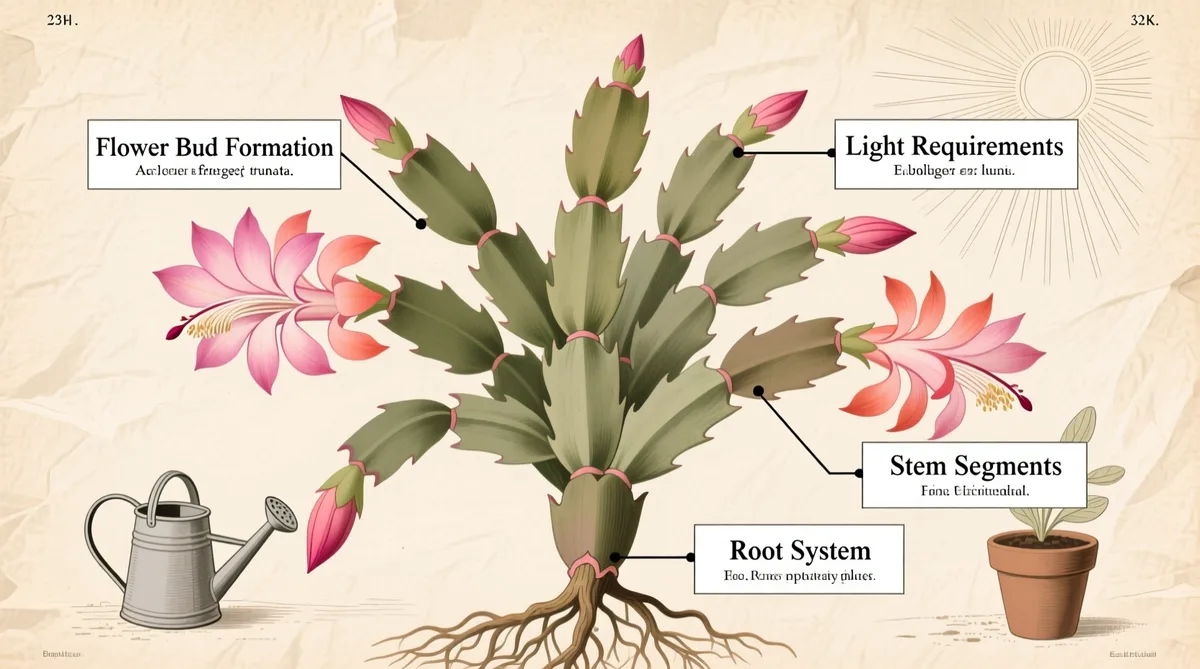
Image source: Bing (Web (fair-use with source credit))
Start the treatment about six to eight weeks before you want flowers. For a Thanksgiving cactus to bloom in November, start around mid September. For a Christmas cactus to bloom around Christmas, start in mid October.
Each day, give the plant at least 14 hours of total darkness. No street light, no kitchen light, no night light. Place it inside a closet, in a cabinet, or cover it with a light proof box or bag.
During the remaining hours, give it bright indirect light as normal.
| Treatment step | Timing | Detail |
|---|---|---|
| Start dark treatment | 8 weeks before target bloom | Move plant to absolute darkness for 14+ hours |
| Continue nightly | Every night for 6-8 weeks | No interrupted darkness, no peeking |
| Watch for buds | 4-6 weeks into treatment | Tiny green bumps appear at leaf tips |
| End dark treatment | Buds are pinhead sized | Return to normal light, do not move pot |
During this period, keep the temperature cool at night. Ideal is 10 to 15 degrees Celsius (50 to 60 degrees Fahrenheit). Do not fertilize and water only lightly.
Once you see small pink buds at the tips of the leaves, you can stop the darkness treatment. Move the plant back to its normal spot. Do not move the pot again once buds appear.
Moving it to a different location at this stage can trigger bud drop.
The same treatment works for Easter cactus, but start it in late January or early February instead.
This is where most holiday cactus care advice gets vague. The key is strict discipline with darkness. A single bright interruption can reset the entire cycle.
Frequently Asked Questions
Why are the leaves on my holiday cactus turning purple or red?
That is sun stress. The plant is getting too much direct light. Move it to a spot with bright but indirect light.
The color should return to green within a few weeks, as long as the leaves are not burned.
How often should I water my holiday cactus?
Only when the top 2 to 3 centimeters of soil feel dry. Stick your finger into the soil. If it feels dry at the second knuckle, water deeply.
If still damp, wait. Overwatering is the fastest way to kill them.
Why did my cactus drop all its buds before opening?
Bud drop is almost always caused by a sudden change in temperature, light, or humidity. A draft from a cold window, a heater vent blasting warm air, or moving the pot to a new room mid bloom can trigger it. Keep the plant stable once buds appear.
Can I keep my holiday cactus outdoors?
Yes, in summer. Move it outside after the last frost, into a shaded spot with no direct afternoon sun. Bring it back indoors before nighttime temperatures drop below 10 degrees Celsius (50 degrees Fahrenheit) in fall.
Is holiday cactus toxic to pets?
No. According to the ASPCA, all three types are non toxic to dogs, cats, and horses. They are safe to keep in homes with pets.
Of course, nibbling any plant can cause mild stomach upset, but it is not an emergency.
Repotting and Propagation: Step by Step
When to repot. Only repot after the plant has finished flowering. Doing it during bloom drops every bud. You will know it is time when roots start growing out of the drainage holes or the soil dries out very fast.
This happens every two to three years.
What pot to use. Choose a pot that is only 2 to 5 centimeters larger in diameter than the current one. Too big a pot holds too much moisture and causes root rot. Ensure the pot has drainage holes.
What soil to use. Use a very loose, well draining mix. Combine two parts regular potting soil with one part orchid bark or perlite. Do not use garden soil or heavy mixes.
The roots need airflow.
How to repot. Gently slide the cactus out of its old pot. Loosen the root ball carefully. Trim away any dark, mushy roots.
Place the plant into the new pot at the same soil depth as before. Fill around it with fresh mix, then water lightly.
How to propagate. You can root single leaf segments directly in water or damp soil. Take a healthy segment, let the cut end dry for a day, then stick it into a small pot of moist perlite or water. Roots appear in two to four weeks.
Propagating is easiest right after the blooming period ends.