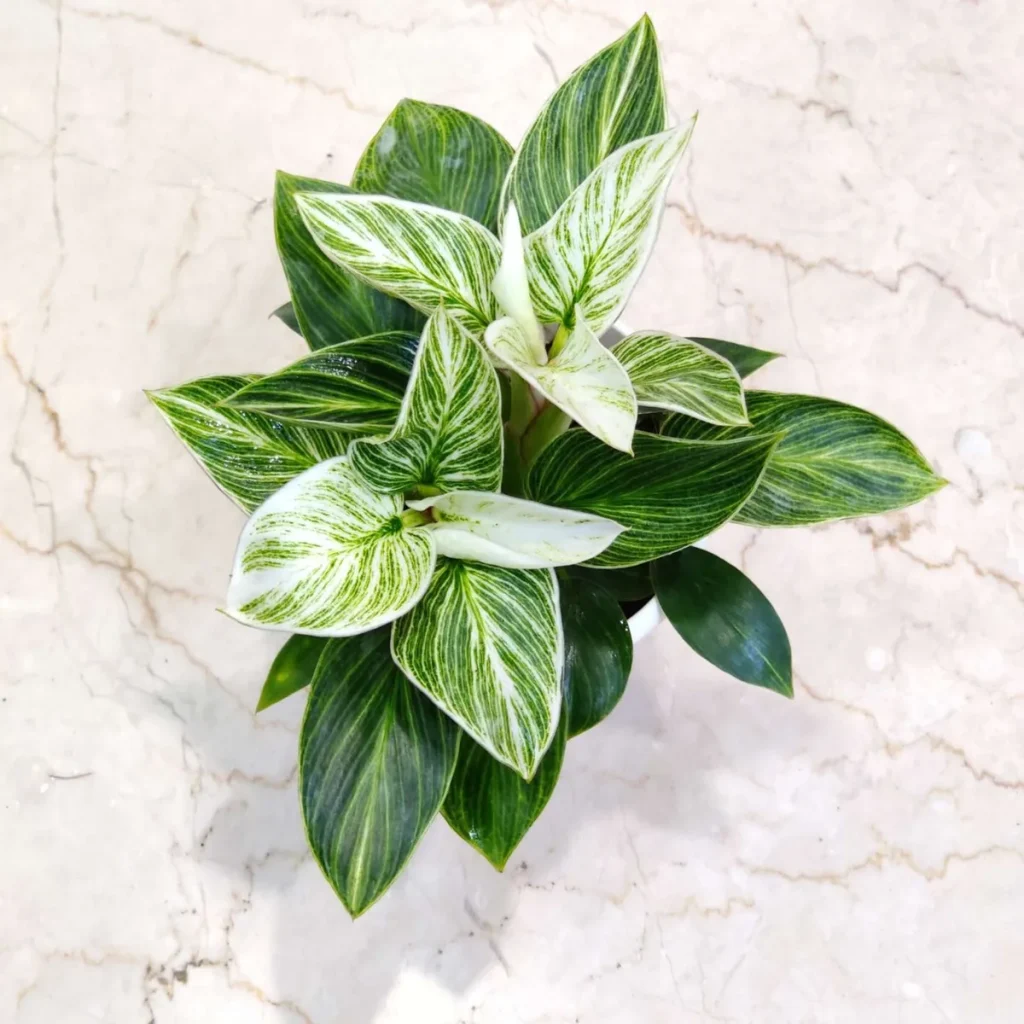
Just when you think you've got your philodendron birkin care dialed in, a leaf goes yellow. Or worse, it unfurls solid green. You're not alone, and you didn't suddenly lose your plant touch.
That dramatic little thing, with its white pinstripes and compact personality, sends mixed signals on purpose.
Philodendron Birkin care isn't complicated once you learn to read the leaves like a dashboard. According to manufacturer and grower specifications, this plant is a stable sport of Philodendron Rojo Congo. It has a genetic quirk that explains both those gorgeous white streaks and its frustrating habit of going green.
Let's decode what your Birkin is actually telling you.
Quick Answer
Water when the top two inches of soil are dry. Give it bright indirect light. Use a chunky aroid mix.
Keep humidity above 40 percent. Prune green leaves to preserve variegation. That's the short version.
Why Your Birkin Suddenly Looks Different — and How to Read It
If you've owned a Birkin for more than a few months, you've probably panicked at least once. A leaf turns yellow. Another one curls inward like a taco.
And the new leaf coming in looks dark green instead of striped. None of these mean you're failing. They mean your plant is reacting to something.
Every Birkin decision starts with observation. The leaves are your signal system. If you check the plant before you water, actually look at the leaves and feel the soil, you can catch problems before they spiral.
Here's the core principle most generic advice misses: Birkins hate inconsistency more than they hate almost any specific condition. A Birkin that gets watered every 8 days like clockwork will outperform one that gets perfect care but on a chaotic schedule. Same goes for light and temperature.
So before you change anything drastic, sit with the plant for a week. Note the light at different times of day. Stick your finger in the soil.
Feel the weight of the pot after watering and again a few days later. That baseline matters.
The Birkin Decision Tree: Water, Light, Reversion, and Leaves
This is where we stop guessing and start diagnosing. Below are the four most common Birkin complaints. Find the one that matches your plant and follow the branch.
Branch 1: Yellowing Leaves — Wet Soil vs. Dry Soil
Yellow leaves are the most common Birkin panic call. The fix depends entirely on which type of yellow you're seeing and where on the plant it shows up.
If the lower, older leaves are yellowing and the soil is dry: You're under-watering. The plant is sacrificing old leaves to keep new ones alive. Water thoroughly and check the pot weight in a few days.
Increase frequency by 1 day.
If lower leaves are yellow and the soil feels wet or heavy: This is over-watering. The roots are suffocating. Stop watering until the top three inches are bone dry.
If the stem feels mushy where it meets the soil, you likely have root rot. Unpot, trim black mushy roots, and repot in fresh dry mix.
If multiple leaves across the plant turn pale yellow at once: Check for root rot or a pot that's too large. A pot that holds too much wet soil relative to root mass will keep the Birkin in constant moisture stress. Drop down a pot size if needed.
The rule of thumb: One yellow lower leaf every few months is normal aging. Three yellow leaves in one week is a problem.
Branch 2: Curling or Crispy Leaves — Humidity and Stress
Birkin leaves that curl inward or develop crispy brown edges are almost always telling you one thing: the air is too dry or the water is inconsistent.
If the leaf edges are crispy but the soil is moist: The humidity is too low. Average home humidity (around 30 percent) is below what this plant prefers. A Birkin can survive at 30 percent but it won't look happy.
The thin white variegated areas crisp first because they have less chlorophyll and hold less moisture.
If the whole leaf is curled like a tube and the soil is dry: You waited too long to water. The plant pulled moisture from the leaves to keep roots alive. Water immediately and expect leaves to take 24 to 48 hours to relax.
If leaves are curled and the soil is wet: This is root rot. The roots can't take up water so the leaves dehydrate even though the pot is wet. Stop watering, check roots, repot if needed.
Practical fix for dry air: Group plants together, use a pebble tray, or run a humidifier in the room. A consistent 50 to 60 percent humidity keeps leaf edges smooth. As of 2026, most affordable ultrasonic humidifiers under 50 dollars can maintain that level in a standard bedroom.
Branch 3: Green Leaves Taking Over — Reversion and Light
This is the Birkin's signature drama. A new leaf unfurls solid green. Another one comes in with just a faint white stripe.
Before you know it, the whole plant looks like a regular green philodendron. That's reversion.
Reversion is genetic. The Birkin is a spontaneous mutation of Rojo Congo, and that mutation is unstable. The plant can switch back to its green parent form if conditions don't support variegation, or even if they do.
The main driver is light. Birkins need bright indirect light, around 2000 to 3500 foot-candles, to keep producing white stripes. Too little light and the plant decides green leaves are more efficient. Too much direct sun and the white areas burn brown.
If you see solid green leaves but the plant is in good light: Prune the all-green leaves back to the stem. Cut just above a node. This encourages the plant to push new growth from lower nodes that may still carry variegation genetics.
Do not cut all the green leaves at once; remove one or two and wait for new growth.
If every new leaf for months has been solid green: Move the plant to brighter light. An east-facing window is ideal. South-facing works with a sheer curtain.
North-facing is too dim. If you can't provide natural light, a full-spectrum LED grow light 6 to 8 inches above the plant for 10 to 12 hours a day will maintain variegation.
Important note: Once a leaf is fully green, it will never develop white stripes. You cannot reverse a reverted leaf. You can only prune it and hope the next one has better genetics.
Branch 4: Brown Bumps (Edema) — Inconsistent Watering
Those small brown corky bumps on the underside of leaves look alarming but they are not a disease. Edema is a physical response to inconsistent watering.
When the soil stays wet for days then dries out completely, the plant's cells swell, burst, and scar over. That scar tissue looks like brown warts or bumps. It's cosmetic.
The leaf still works.
To stop edema: Water on a consistent schedule. Don't let the soil go from bone dry to soaking wet. A moisture meter helps here.
Water when the meter reads 3 to 4 (on a 1 to 10 scale) rather than waiting for 1 or 2.
Bottom watering can help. Fill a tray with water and let the pot sit for 15 to 20 minutes. The soil absorbs water evenly from below, which reduces the dramatic wet-to-dry swings that cause edema.
Edema won't kill your Birkin. But if you see it on every new leaf, your watering routine needs smoothing out.
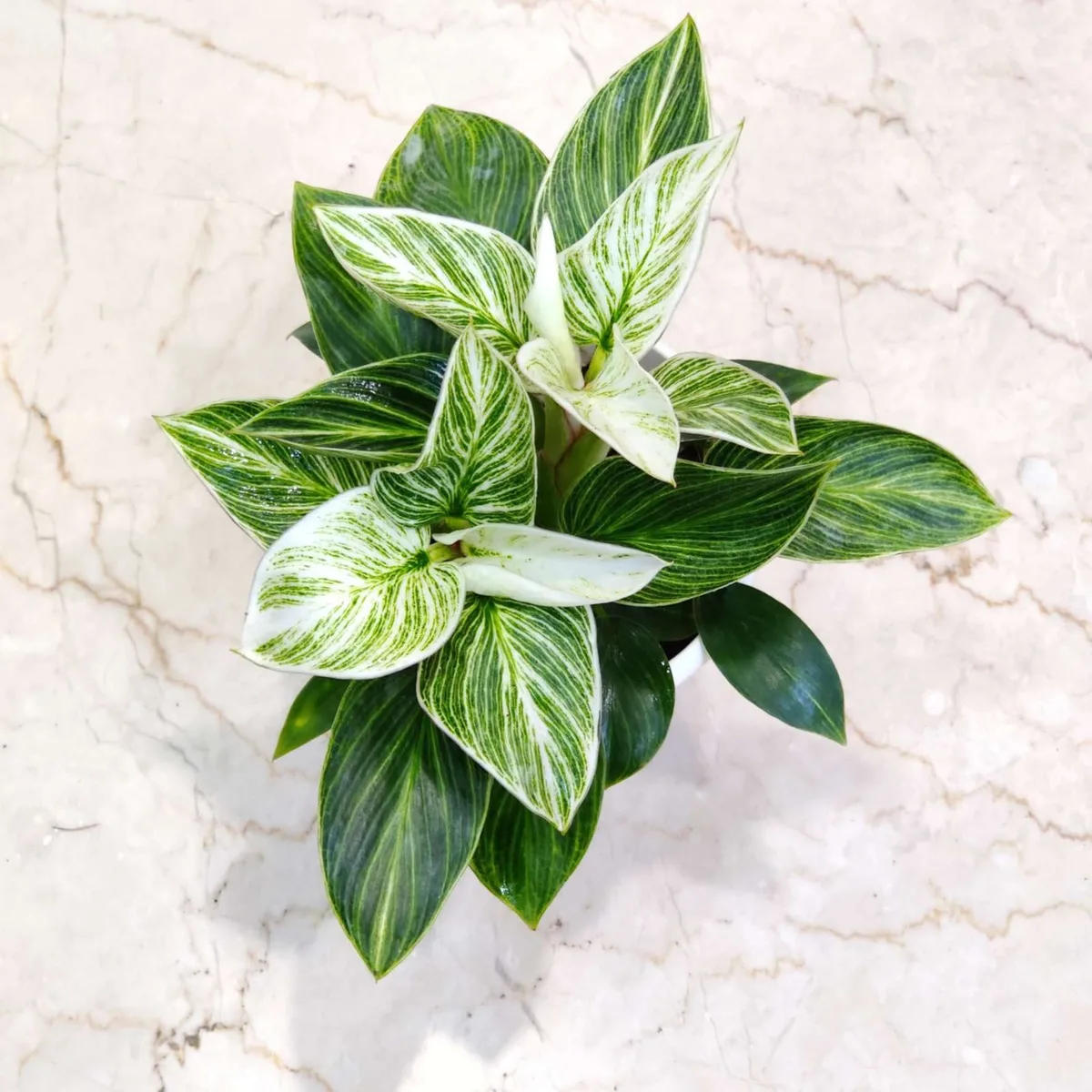
Image source: Web (Bing) / sanjaynursery.com (Web image (fair-use with source credit))
Steps for Fixing a Reverted Philodendron Birkin (and Pruning Right)
Reversion is the most emotionally charged Birkin problem. You bought the plant for those white stripes. Watching them disappear feels like a loss.
But here's the truth: you can manage reversion. You just have to approach it like a gardener, not a fan.
Step 1: Identify which leaves are reverted. A reverted leaf is solid green with no white pinstripes. Some leaves may be partially variegated. Those are fine to keep.
Step 2: Cut the fully green leaves. Use sterilized pruning shears or scissors. Cut the stem at a 45-degree angle about an inch above the soil line or just above a node. Removing the green leaves redirects energy to variegated growth points.
Step 3: Assess the light situation. If the plant is in a dim corner, move it. Bright indirect light is non-negotiable for variegation. A Birkin in low light will revert within two or three leaf cycles.
Step 4: Be patient. After pruning, the plant may take 4 to 6 weeks to push new growth. The first leaf after pruning might still be green. That's okay.
Sometimes it takes two or three pruning rounds to coax a variegated leaf back.
Step 5: Accept the limitations. Some Birkins are genetically prone to reversion no matter what you do. If you've given it perfect light, good soil, and consistent watering and it still produces green leaves, that specific plant may have lost the variegation mutation in its growth point permanently. In that case, you have a beautiful green philodendron.
It's still healthy. It's just not striped.
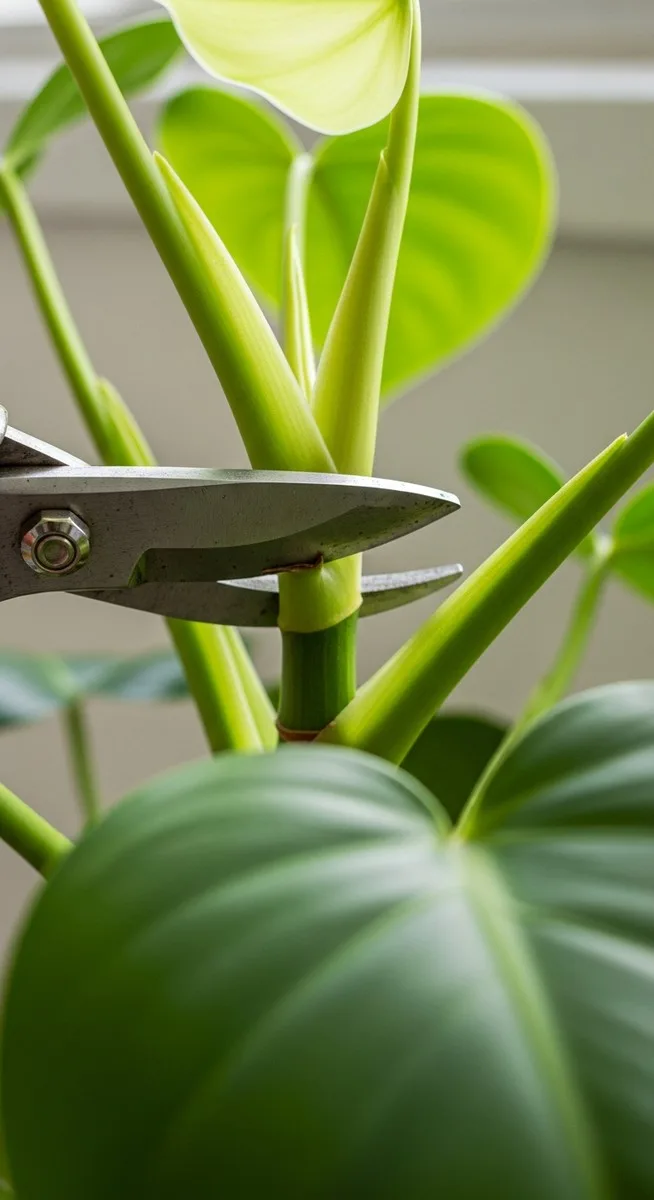
Image source: Web (Bing) / houseplantauthority.com (Web image (fair-use with source credit))
Mistakes That Kill Birkins — and the Symptoms They Cause
Most Birkin deaths don't happen from one big error. They happen from small repeated mistakes that compound over weeks. Here are the four most common ones and exactly how they show up.
Mistake 1: Watering on a calendar. "I water every Sunday" sounds disciplined. But a Birkin's water needs change with seasons, growth spurts, and home conditions. Watering on a fixed schedule guarantees over-watering in winter and under-watering in summer.
Fix: check soil moisture before every watering. The calendar is a backup, not the rule.
Mistake 2: Using dense potting soil. Standard potting mix holds too much water for a Birkin. The roots need air pockets. A dense mix leads to root rot within weeks.
Fix: use a chunky aroid mix with orchid bark, perlite, and coco coir. The mix should feel light and crumbly in your hands.
Mistake 3: Ignoring the light angle. A Birkin can get enough total light but still revert if the light comes from the wrong direction. A plant sitting in front of a north-facing window gets dim ambient light all day. That works for a snake plant but not a variegated Birkin.
Fix: watch the shadows. If the plant's shadow is soft and faint, the light is too weak.
Mistake 4: Removing the wrong leaves. When reversion starts, people often remove the prettiest white leaves because they think the plant is "saving energy" for green ones. That's backward. The green leaves are the ones draining variegation energy.
Remove the green, keep the white.
Long-Term Maintenance: Soil, Feeding, and Seasonal Changes
A Birkin that's past the first year needs a different rhythm than a fresh nursery plant. The soil breaks down. The roots fill the pot.
The growth slows in winter. Here's how to keep it thriving through all of that.
Soil refresh every 12 to 18 months. That chunky aroid mix you started with will eventually compact. When water runs straight through the pot without soaking in, the soil structure is gone. Repot with fresh mix, even if you keep the same pot size.
Gently shake off the old soil and remove any dead roots before replanting.
Feeding schedule. Birkins are not heavy feeders. Fertilize once a month during spring and summer with a balanced liquid houseplant fertilizer diluted to half strength. Stop feeding entirely from November through February.
The plant's growth slows in low light, and unused fertilizer salts build up in the soil and burn the roots.
Seasonal watering adjustments. In winter, a Birkin can go 10 to 14 days between waterings. In summer, it might need water every 5 to 7 days. The soil dries slower in cool, dim conditions.
Check with your finger, not the calendar.
When to repot. Only move up one pot size, and only when you see roots circling the bottom or poking out of drainage holes. A Birkin packed into a snug pot often produces better variegation than one swimming in excess soil. Extra wet soil encourages reversion and root rot.
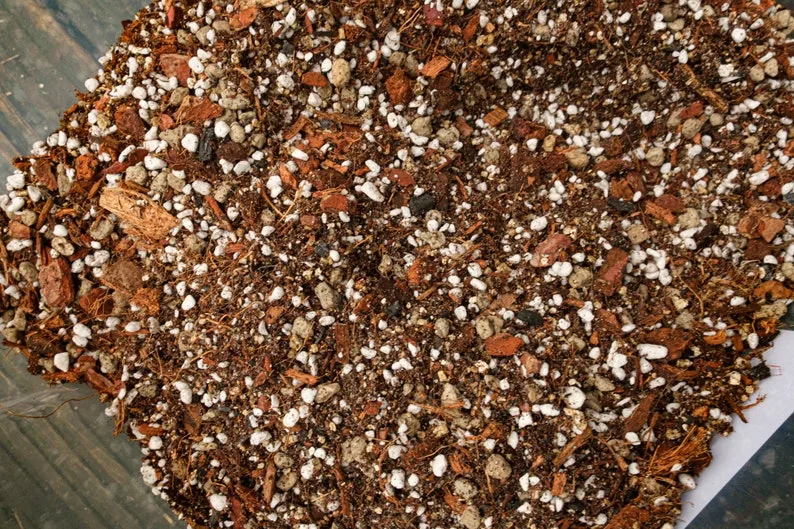
Image source: Bing (Web (fair-use with source credit))
Frequently Asked Questions
How often should I water my Philodendron Birkin?
Water when the top two inches of soil are dry. In average home conditions, that works out to every 7 to 10 days. Stick your finger into the soil rather than guessing.
A moisture meter reading of 3 or 4 confirms it's time to water.
Why is my Birkin growing all green leaves?
That's reversion. It happens when the plant gets too little light or when the genetic mutation stabilizes back to the parent Rojo Congo. Move it to brighter indirect light and prune the green leaves.
Some plants simply revert permanently no matter what you do.
Can I cut back a leggy Philodendron Birkin?
Yes. Leggy growth means the plant is stretching toward light. Cut the stem just above a node and move the plant to brighter light.
You can root the cutting in water or moist sphagnum moss to propagate a new plant.
Should I mist my Birkin for humidity?
Misting provides temporary relief but can cause leaf spots and fungal issues if water sits on the leaves overnight. A humidifier or pebble tray is more effective for raising ambient humidity around the plant.
Is the Philodendron Birkin toxic to cats and dogs?
Yes, it contains calcium oxalate crystals that cause oral irritation, drooling, and mild vomiting if ingested. The ASPCA lists it as toxic but not typically fatal. Keep it out of reach of pets and children.
Final Verdict: Is the Birkin Still Worth the Drama?
The Philodendron Birkin is not a set-it-and-forget-it plant. It demands attention, consistent care, and a willingness to accept that some leaves will go green. But for the price of a typical houseplant, you get something that looks like it costs three times as much.
If you enjoy the puzzle of reading leaves and adjusting care accordingly, you'll love owning a Birkin. If you want a plant that looks perfect with zero effort, choose a pothos or a snake plant instead.
The Birkin rewards the observant grower. It punishes the distracted one. Know which type you are before you bring one home, and you'll be fine either way.



