Growing carrots from seed is one of those gardening challenges that looks simple on paper but trips up a surprising number of people. You scatter the seeds, you water them, and then nothing happens for two weeks. Or the seedlings come up so thick you have to pull half of them out.
Or the roots end up stunted and forked. If you've ever thought carrots are fussy, you're not wrong, but they're not impossible.
The reality is that carrot seeds are tiny (about 2,000 per gram), slow to germinate, and incredibly sensitive to soil conditions. As of 2026, aggregate reviews from home gardeners still point to the same three hurdles: soil crusting, inconsistent moisture, and improper thinning. Get those right, and you're most of the way there.
Let's walk through exactly how to grow carrots from seed, decision by decision.
Quick Answer
Sow carrot seeds directly into loose, rock-free soil. Plant them ¼ inch deep and keep the top inch of soil consistently damp. Germination takes 10 to 21 days.
Thin seedlings to 2 inches apart once they're a couple inches tall. Harvest in 50 to 80 days. Carrots don't transplant well.
Always direct sow.
Why Growing Carrots from Seed Is Tricky (But Totally Doable)
Carrot seeds have a built-in disadvantage. They're small, shallowly planted, and slow to sprout. While a bean seed can push through a light crust of soil, a carrot seed can't.
If the soil surface dries out and forms a hard layer, the emerging seedling simply dies beneath it.
There's also the moisture problem. Carrot seeds need consistent dampness near the surface for the full germination window. Miss a day of watering during a dry spell, and you lose that batch.
This is why many first-time gardeners end up with bare rows and no idea what went wrong.
The good news? These problems are entirely preventable with the right technique. Our research across university extension services and experienced home gardeners shows that paying careful attention to soil preparation and moisture management flips the success rate from frustrating to reliable.
Once you understand what carrot seeds actually need, the process becomes straightforward.
The Two Biggest Decisions Before You Plant: Variety and Seed Type
Which carrot variety should you pick?
Carrot varieties aren't interchangeable. Each type has a different root shape, length, and soil requirement. The four main groups are Nantes, Danvers, Chantenay, and Imperator.
| Variety | Root Shape | Best Soil Type | Days to Maturity | Best For |
|---|---|---|---|---|
| Nantes | Cylindrical, blunt tip | Loose, deep soil | 60-70 | Fresh eating, home gardens |
| Danvers | Tapered, strong top | Heavy or clay soil | 65-75 | Storage, canning |
| Chantenay | Short, thick, broad shoulder | Shallow or rocky soil | 55-65 | Heavy soils, containers |
| Imperator | Long, slender, pointed | Deep, sandy loam | 70-80 | Grocery-store style, commercial |
If you're growing in a raised bed or container, go with Chantenay or Nantes. If you're planting directly into garden soil that's on the heavy side, Danvers is the most forgiving choice. Imperator varieties need deep, fluffy soil and more patience, they're not ideal for beginners.
Raw seed or pelleted seed?
Standard raw carrot seeds are cheap and last up to three years in cool dry storage, but they're tiny and hard to space evenly. Pelleted seeds are coated with a clay-like material that makes them larger and easier to handle. The trade-off is that the coating needs consistent moisture to dissolve properly.
If the pellet doesn't break down, the seed won't germinate.
Our take? Pelleted seeds are worth the extra cost for beginners. They make spacing far easier, which reduces the amount of thinning you'll need to do later.
Just be extra careful about keeping the soil consistently damp for the first 10 days.
Step-by-Step: How to Sow Carrots for Reliable Germination
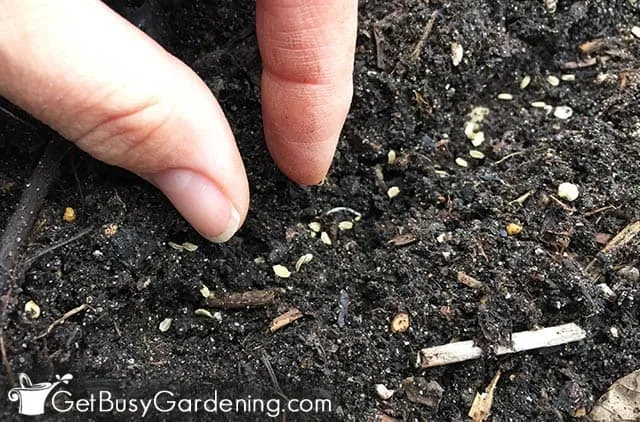
Image source: Web (Bing) / getbusygardening.com
Step 1: Prepare the soil. Remove every rock and clod down to about 10 inches deep. Carrot roots will fork or twist when they hit an obstruction. Rake the surface to a fine, crumbly texture.
Think of it as giving the seeds a soft landing.
Step 2: Create a shallow furrow. Use a stick, the edge of a trowel, or your finger to draw a trench about ¼ to ½ inch deep. For reference, that's about as deep as your fingernail. Water the furrow lightly before sowing, this prevents the seeds from washing away.
Step 3: Sow the seeds. If you're using raw seeds, mix them with a bit of dry sand in a salt shaker to help with even distribution. With pelleted seeds, place one seed every 1 to 2 inches along the furrow. Cover them with a fine layer of soil, no more than ½ inch, and press it down gently with your palm.
Good seed-to-soil contact is critical.
Step 4: Keep the soil moist. This is the non-negotiable step. Cover the seeded row with a lightweight fabric, shade cloth, or even a thin layer of damp burlap. This keeps the surface from drying out and protects against heavy rain that can wash seeds away.
Check daily and water lightly if the top inch feels dry.
Step 5: Wait and watch. Carrot seeds take 10 to 21 days to germinate, depending on soil temperature. At 60°F (15°C), expect closer to three weeks. At 70-75°F (21-24°C), you'll see sprouts in about 10 days.
Remove any covering once seedlings appear, they need full sun right away.
Thinning: The Step Most Gardeners Get Wrong
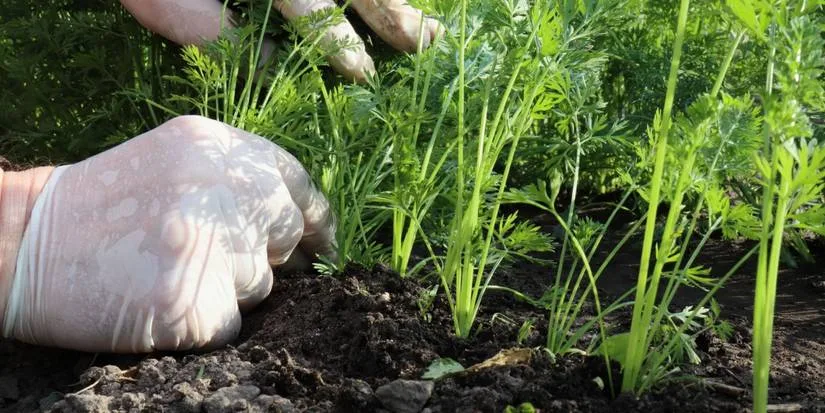
Image source: Web (Bing) / backyardboss.net
Thinning is the step people hate. You spend weeks coaxing those tiny seedlings out of the ground, and then you have to pull most of them out. But here's the truth from every university extension guide we've studied: if you don't thin properly, you won't get full-sized carrots.
Period.
Carrots need space underground to develop their taproot. When seedlings are crowded, the roots compete for moisture and nutrients, and they end up tangled, stunted, or twisted. A densely packed row of carrot tops might look lush, but what's underneath is a mess.
Thin in two passes. When the seedlings are about 1 to 2 inches tall, pull or snip the smallest ones so the remaining plants are about 1 inch apart. Use scissors rather than pulling by hand, pulling can disturb the roots of the seedlings you want to keep. Then, when the tops are about 4 inches tall, thin again to a final spacing of 2 to 3 inches apart for full-size carrots.
If you're growing baby carrots, you can leave them closer together at about 1 inch apart.
Don't toss those thinnings. Small carrot tops are edible and make a great addition to salads or pesto. It's a small consolation for the pain of thinning, but it helps.
Watering and Weeding: Keeping Carrots Happy Through the Season
Once your carrot seedlings are thinned and established, the heavy lifting is done. But the season isn't over. Two things will make or break your harvest from here: consistent watering and clean weed control.
Carrots need about 1 inch of water per week from rain or irrigation. The key word is "consistent." If you let the soil dry out for several days and then drench it, the roots can crack or develop a tough, woody texture. A soaker hose or drip line is ideal because it delivers water directly to the soil without wetting the foliage, wet leaves invite disease.
Weeds are a more immediate problem. Carrot seedlings are slow and delicate, and fast-growing weeds can easily shade them out or outcompete them for moisture. Hand-pull weeds carefully when they're small, being careful not to disturb the carrot roots.
A light mulch of straw or grass clippings applied after thinning can suppress weeds and retain moisture, but keep the mulch layer thin, no more than an inch, and don't let it touch the carrot crowns directly.
When to Harvest (And How to Store for Months)
Carrots don't shout at you when they're ready. You have to check. The general rule is that most varieties are ready 50 to 80 days after sowing, depending on the variety and your soil temperature.
But calendar days are only a rough guide.
The most reliable test is to gently brush away the soil at the shoulder of the root. If the carrot measures about ½ to 1 inch across at the top, it's ready for full harvest. For baby carrots, you can pull them earlier at around 30 to 40 days.
They'll be smaller but sweeter.
Harvest timing also depends on the weather. Carrots left in the ground after a light frost actually get sweeter. The plant converts starches into sugars as a natural antifreeze.
That's why fall carrots often taste better than spring ones. But if a hard freeze is coming, pull them all. Frozen carrots turn to mush when thawed.
How to harvest: Water the soil lightly the day before to soften it. Loosen the soil around each carrot with a garden fork, then pull the root by gripping the tops near the base. If the tops break off, dig carefully with your hands or a trowel.
Storage tips for long-term keeping:
- Cut the green tops off to about ½ inch above the root. The tops draw moisture from the root and cause wilting.
- Do not wash the carrots until you're ready to use them. Dirt protects them.
- Store in a plastic bag with small holes or in damp sand in a cool, dark place.
- Ideal storage conditions: 32°F to 38°F (0°C to 3°C) with high humidity.
- In these conditions, fall-harvested carrots can last 4 to 6 months. Danvers and Chantenay varieties store best.
If you don't have a root cellar or refrigerator space, you can also leave carrots in the ground under a thick layer of mulch. Cover them with 12 to 18 inches of straw or leaves before the ground freezes. Then pull them as needed through winter.
Many cold-climate gardeners rely on this method.
Frequently Asked Questions
Why won't my carrot seeds germinate?
The most common reason is inconsistent moisture. Carrot seeds must stay constantly damp for 10 to 21 days. If the soil surface dries out even once, the tiny seeds die.
Other causes include soil temperature below 50°F (10°C) or a hard crust forming on top.
Can I transplant carrot seedlings?
No. Carrots have a fragile taproot that does not survive transplanting. Always direct sow into the final growing spot.
If you must move them, do it when seedlings are less than a week old and disturb the root as little as possible. Even then, success is low.
How deep should I plant carrot seeds?
Plant them ¼ to ½ inch deep. In sandy soil, go closer to ½ inch. In heavy clay, stick to ¼ inch.
The biggest mistake is planting too deep. Seeds sown deeper than ½ inch often fail to emerge.
Do carrots need a lot of sun?
Yes. Carrots need full sun at least 6 to 8 hours per day. Less sun means slower growth and smaller roots.
Partial shade is possible in hot climates where afternoon shade prevents bolting, but yields will be lower.
Should I fertilize carrots?
Minimally. Carrots grow best in moderately fertile soil. Too much nitrogen produces bushy tops with small, forked roots.
A light application of low-nitrogen fertilizer (5-10-10) at planting time is enough. Avoid fresh manure.
Why are my carrots forked or twisted?
Forked roots are almost always caused by physical obstacles in the soil: rocks, clumps of clay, compacted layers, or fresh organic matter that hasn't fully decomposed. Prepare the bed 10 inches deep and remove every obstruction before sowing.